The goalless Premier League meeting between Tottenham Hotspur and Everton has been followed by a major refereeing debate.

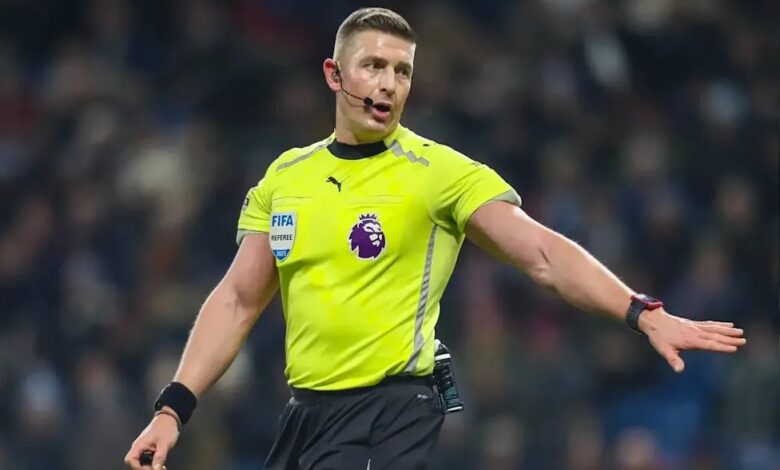
PGMOL Under Pressure as Major Refereeing Controversy Overshadows Tottenham vs Everton Clash
The goalless Premier League meeting between Tottenham Hotspur and Everton has been followed by a major refereeing debate, with fresh attention now being placed on an incident that occurred during the match. The situation has quickly attracted interest because of the involvement of both the on-field referee and the Video Assistant Referee (VAR), with questions being raised over whether the correct decision was made.
The match was already tense, with both sides fighting for control and looking to create an important breakthrough. However, one particular incident has now become the centre of attention after footage appeared to raise further questions about the decision made at the time.
According to the information presented in the image, PGMOL has immediately confirmed that the referee and VAR made a significant mistake during the Tottenham versus Everton encounter. That claim has added another layer to an already controversial situation and is likely to generate plenty of discussion among supporters of both clubs.
The incident shown in the footage involved an Everton player going to ground inside the area, while a Tottenham player was nearby. The images have naturally led to questions about whether the situation should have resulted in a different decision from the officials.
With VAR introduced to help referees review potentially game-changing incidents, supporters have increasingly expected major decisions to be examined carefully. When an incident appears controversial despite the presence of video technology, the frustration can become even greater.
The role of PGMOL chief Howard Webb is particularly significant in discussions surrounding controversial Premier League decisions. Webb has previously explained that VAR is designed to correct clear and obvious errors rather than intervene in every incident. However, when an important decision is subsequently judged to have been wrong, it inevitably raises questions about the process followed inside the VAR room.
In this particular case, the focus is now on why the incident was handled in the way it was and whether the available footage should have prompted a different intervention.
The identity of the referee also matters because Michael Oliver was in charge of the Tottenham-Everton fixture, while Paul Tierney was responsible for VAR duties. Their involvement makes the controversy even more significant, particularly because both officials are experienced figures within Premier League refereeing.
The attention is therefore not simply about one moment in an otherwise goalless game. It is about the wider question of whether the officials made full and correct use of the technology available to them.
For Everton, moments like this can be particularly frustrating because a single refereeing decision can potentially influence the direction of an entire match. When a team is searching for a goal in a tight contest, a penalty decision or a failure to intervene on a significant incident can become extremely important.
Tottenham, meanwhile, will also be aware of the controversy because the decision occurred during a match in which attacking opportunities were limited. The final 0-0 scoreline means there was no winning goal to dominate the headlines, leaving the refereeing incident as one of the major talking points surrounding the fixture. Contemporary reports confirm that Tottenham and Everton finished the match level at 0-0.
The wider issue is the credibility of VAR itself. The technology was introduced to reduce major mistakes, but controversial decisions continue to fuel debates about consistency, interpretation and the threshold for intervention.
Supporters do not necessarily expect every decision to be perfect. Football remains a fast-moving sport, and referees have to make decisions in difficult circumstances. What fans increasingly expect, however, is consistency and transparency when technology is available to review an incident.
That is why any confirmation of an officiating mistake by PGMOL can attract such significant attention. It effectively acknowledges that something went wrong in a process specifically designed to prevent major errors.
Howard Webb has previously been involved in explaining controversial Premier League decisions and has regularly stressed the importance of understanding how referees and VAR officials arrive at their conclusions. PGMOL and the Premier League have also used official programmes to explain key refereeing decisions and VAR processes to the public.
The latest controversy will therefore put renewed attention on the standard of officiating in the Premier League. Fans will want to know exactly what happened, what the officials saw, and why the decision was allowed to stand at the time.
For the players involved, however, the incident is only part of the story. The match itself ended without a goal, meaning neither Tottenham nor Everton could claim the three points they desperately wanted.
The incident may now continue to dominate the conversation long after the final whistle, especially if further explanations, footage or official comments emerge.
Ultimately, the controversy highlights one of the biggest challenges facing modern football: balancing human judgment with technology. VAR was supposed to provide greater accuracy and eliminate obvious mistakes, but when the technology itself becomes the centre of the controversy, questions naturally follow.
For now, the attention remains firmly on the decision, the officials involved and the explanation surrounding it. What was already a tightly contested Tottenham-Everton match has now produced another major talking point for Premier League supporters—and the refereeing debate is showing no signs of disappearing anytime soon.