The financial landscape of the Scottish Premiership has once again highlighted the huge difference in spending power between the clubs

Every Scottish Premiership Club Ranked by Their Annual Wage Bill for 2026/27
The financial landscape of the Scottish Premiership has once again highlighted the huge difference in spending power between the clubs competing at the top level of Scottish football.
With the 2026/27 campaign underway, wage bills provide an interesting indication of the financial resources available to each club. While money does not automatically guarantee success on the pitch, clubs with larger wage budgets generally have greater capacity to attract experienced players, retain important stars and build deeper squads.
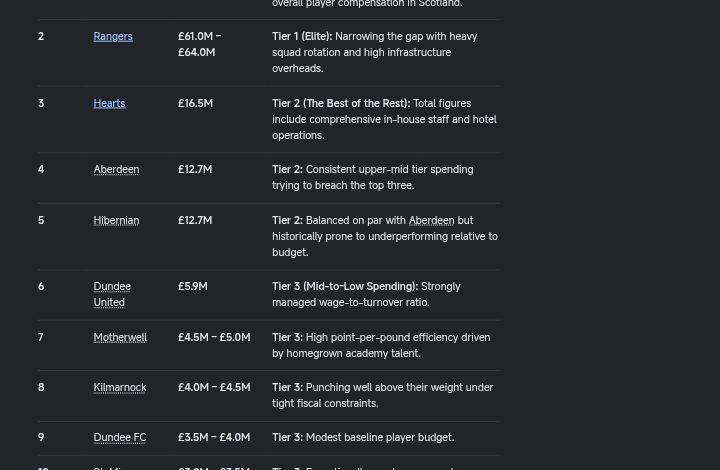
Based on the wage-bill figures provided, Celtic sit comfortably at the top of the Scottish Premiership, with an estimated annual wage bill of more than £65 million. Rangers are second on approximately £61m–£64m, demonstrating the enormous financial gap between Scotland’s two biggest clubs and the rest of the division.
Celtic’s position is hardly surprising given their dominance of Scottish football in recent years. They entered the 2026/27 campaign as five-time defending champions, having secured a record-setting 56th league title last season. Their financial strength also allows them to maintain a squad capable of competing domestically while dealing with European commitments.
Rangers are not far behind. Their estimated wage bill of between £61m and £64m places them firmly in the same financial category as Celtic. The gap between the Old Firm and the rest of the league is therefore substantial.
Hearts occupy third place, with an estimated annual wage bill of £16.5m. That represents a significant drop from the figures recorded by Celtic and Rangers, but Hearts remain comfortably ahead of the other clubs outside the Old Firm. Their position reflects their status as one of the strongest financial forces among the rest of the Premiership.
In fourth place are Aberdeen, with an estimated wage bill of £12.7m. The figure places Aberdeen among the league’s bigger spenders and shows their ambition to compete near the top end of the table. Aberdeen have also undergone considerable squad changes ahead of the current campaign, with a number of new arrivals coming in during the summer.
Hibernian are next, also listed at approximately £12.7m. Their wage bill is level with Aberdeen’s in the supplied ranking, although the two clubs have experienced very different challenges in recent seasons.
Sixth place belongs to Dundee United, whose estimated annual wage bill stands at £5.9m. That puts them firmly in the middle-to-lower spending category, with the club’s financial structure described as being managed carefully in relation to turnover.
Motherwell are seventh, with an estimated wage bill between £4.5m and £5m. Their position demonstrates the club’s ability to operate with a considerably smaller budget than the league’s biggest spenders while still attempting to remain competitive.
Kilmarnock are eighth, with an estimated annual wage bill of £4m–£4.5m. Despite the relatively modest figure, their spending places them among the clubs attempting to maximise value from limited resources.
Ninth place goes to Dundee FC, whose estimated wage bill is between £3.5m and £4m. The figure highlights the financial reality faced by clubs operating outside the league’s biggest spending groups.
St Mirren are tenth, with an estimated annual wage bill of £3m–£3.5m. Their relatively low spending level makes their ability to compete in the Premiership particularly noteworthy.
Eleventh are St Johnstone, with an estimated wage bill of approximately £2.5m–£3m. Their position places them firmly among the clubs operating with some of the tightest financial restrictions in the division.
Finally, Falkirk/Ross County are listed at the bottom of the supplied ranking with an estimated annual wage bill of under £2.5m. That figure illustrates just how dramatic the financial divide can be within the Scottish Premiership.
Overall, the ranking paints a fascinating picture of Scottish football. Celtic and Rangers operate on an entirely different financial level, while Hearts, Aberdeen and Hibernian form the next spending group. Further down the table, clubs such as Motherwell, Kilmarnock, Dundee, St Mirren and St Johnstone must rely heavily on recruitment strategy, coaching and player development to compete.
And that is what makes the Scottish Premiership so intriguing: the size of a club’s wage bill may influence expectations, but it does not decide what happens on the pitch. Current 2026/27 results already show clubs such as St Mirren and Motherwell competing strongly despite having significantly smaller wage budgets than the Old Firm.