
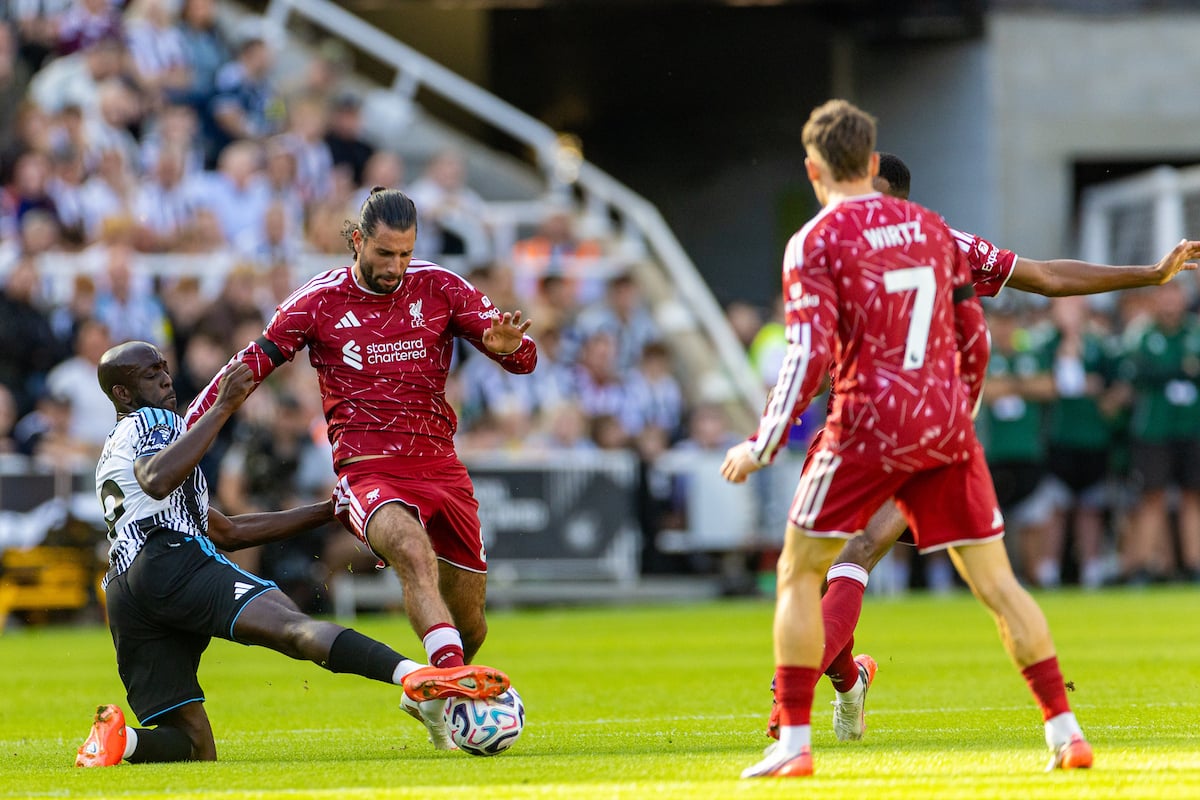
Newcastle Question VAR Credibility as Controversy Explodes Over Liverpool’s Late Penalty
Newcastle United have been left furious after Liverpool rescued a point at St James’ Park through a dramatic stoppage-time penalty, with the decision now becoming one of the biggest talking points from the Premier League’s opening weekend.
The Magpies appeared to be heading towards a memorable victory after twice taking the lead against Liverpool. Anthony Elanga opened the scoring in the fifth minute before Cody Gakpo restored parity for the visitors. Joe Willock then put Newcastle back in front, seemingly setting the stage for a dream start under new manager Matthias Jaissle.
However, deep into stoppage time, the entire contest changed.
Liverpool were awarded a penalty after substitute Victor Muñoz went down following a challenge from Newcastle defender Lewis Hall. Dominik Szoboszlai stepped forward and made no mistake from the spot, sending the ball into the net and securing a 2–2 draw for Liverpool.
The decision immediately sparked debate, with Newcastle supporters and sections of the football community questioning whether the contact was sufficient to justify a penalty. Jaissle himself described the decision as “really soft,” reflecting the frustration within the Newcastle camp after seeing victory disappear in the final moments.
The controversy has been intensified by the emergence of video footage being circulated online, with supporters scrutinising the incident from different angles and arguing that the images tell a different story from the decision made on the pitch. Such footage has inevitably renewed questions about VAR and whether the technology is being applied consistently enough in decisive Premier League moments.
For Newcastle, the frustration is understandable. The team had produced a spirited performance against one of the league’s biggest clubs and looked seconds away from claiming all three points. Instead, a decision in the dying moments meant they had to settle for one.
Yet the debate is not simply about Newcastle and Liverpool. It goes to the heart of the credibility of the Premier League’s refereeing system.
VAR was introduced to reduce major officiating errors and provide referees with an opportunity to correct decisions when necessary. But when a controversial incident remains disputed even after a VAR review, supporters naturally ask what the technology is actually achieving.
The Premier League has defended the decision, with reports explaining that VAR considered the contact between Hall and Muñoz sufficient to support the on-field penalty decision. That explanation, however, has done little to end the argument among Newcastle supporters who believe the contact was too minimal for a spot-kick.
The incident also puts renewed attention on Howard Webb, the chief refereeing figure responsible for overseeing Premier League officials and improving transparency around major decisions. Webb has previously used referee audio and public explanations to demonstrate how VAR decisions are reached, particularly when controversial incidents generate widespread criticism.
That history means supporters will naturally expect clarity when another major decision becomes the subject of intense scrutiny. If officials believe the penalty was correct, explaining precisely why the challenge meets the threshold for a foul inside the box would go a long way towards addressing the criticism.
If, however, further review eventually establishes that the intervention or the original decision was incorrect, the Premier League and PGMOL could face renewed pressure to explain how such an error occurred.
For Newcastle, there is also a bigger lesson from the match. Despite the disappointment of conceding such a late equaliser, Jaissle’s side showed considerable promise. They twice pushed Liverpool into difficult positions and demonstrated the attacking intensity and organisation needed to compete with elite opposition.
Liverpool, meanwhile, showed resilience to avoid defeat. Their performance was not flawless, but they continued fighting until the final whistle and were rewarded with a penalty that allowed Szoboszlai to salvage a point.
The controversy, though, is likely to outlive the result.
A thrilling opening-weekend match has now become another flashpoint in the continuing debate over VAR, refereeing consistency and the level of transparency supporters deserve. Newcastle may have earned only one point, but their questions about the penalty are unlikely to disappear quickly.
As more footage is analysed and the official reasoning receives further scrutiny, pressure will remain on the Premier League and its refereeing leadership to provide a clear answer: was the late penalty the correct decision, or did VAR once again fail at the moment it mattered most?