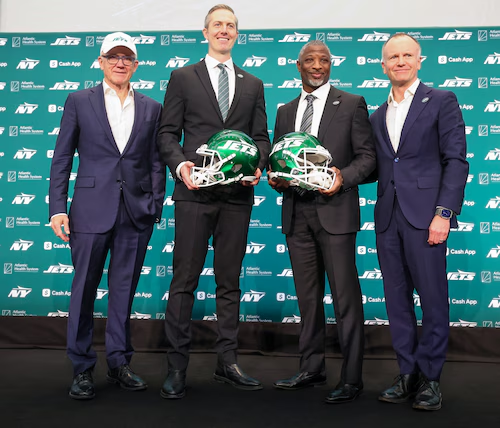
The Jets’ new regime won’t have an easy task in their first offseason on the job. New coach Aaron Glenn and new general manager Darren Mougey have already made their first big decision on the job, moving on from Aaron Rodgers.
And it’s not as if quarterback is the only hole to fill on the roster as they try to end a playoff drought of 14 seasons — the longest active slump in the NFL and across major North American pro sports. No, the Jets will likely need to find multiple new starters at several positions on both sides of the ball. Most notably: wide receiver, right tackle, on the defensive line and at both levels in the secondary.
The good news is they should have a bit more cap space to do it with the NFL announcing this week that the league’s 2025 salary cap is going to be significantly higher than expected, likely in the neighborhood of $280 million.
That leaves the Jets with a modest $23.9 million to spend in the free agency next month — the 20th most in the league, according to Over The Cap.
That doesn’t sound great. But the better news is they have plenty of ways to clear significant cap space before the market opens.
Here are five moves the Jets can make to more than triple their available spending power before NFL free agency kicks off in a few weeks.
CUT AARON RODGERS
The Jets are moving on from Aaron Rodgers, who had no guaranteed money remaining on his contract. The only question now is how they’ll absorb the remaining $49 million cap responsibility he leaves behind.
First of all, why are the Jets still responsible for $49 million? Back in 2023 they signed him to a three-year deal worth up to $112.5 million, with $75 fully guaranteed. The Jets decision to cut him wipes out the $35 million bonus and $2.5 million base salary he would have made for playing in 2025, meaning they’ll only pay him the $75 million guarantee.
Those remaining payments were split into two parts:
*A total of $5 million in base salary. This was split between 2023 and 2024 and has already been paid out.
*And the $70 prorated million signing bonus, which the Jets spread out over seven seasons to lower Rodgers’ cap hit at the beginning of his contract. The Jets have already paid out $21 million of that signing bonus, ($7 million in 2023 and $14 million in 2024) leaving them on the hook for the additional $49 million — also known as “dead money,” since the Jets will be paying the bill for a player who isn’t on their team.
Cut immediately or post-June 1?
If the Jets cut Rodgers immediately, the entire $49 million would surge onto their books for 2025 — instead of the $23.5 million cap hit he would have carried had he remained on the roster. Cutting Rodgers immediately would give the Jets tons of flexibility for the future, because his contract would be completely off the books by 2026. But it would also add $25.5 million to their cap responsibilities for 2025, which is more than the Jets have to spend ($23.9 million, as noted above). They’d have to make more moves to just to clear enough space to sign their rookie class, before they could even think about adding free agents.
That’s why it’s not a surprise the Jets are expected to cut Rodgers with a post-June 1 designation, according to multiple reports.
The post June 1 designation would allow the Jets to spread out his remaining four pro-rated signing bonus payments over the next two years. In 2025, they’d be responsible for only the 2025 pro-rated bonus payment of $14 million. That would save the Jets $9.5 million on Rodgers’ cap hit in 2025, after the move becomes official on June 2 — they’d have to carry his cap hit until then, but they’d still have $25.5 million more to spend in free agency than they would with an immediate cut.
The issue would be in 2026, when that bill would come due with Rodgers costing $35 million against the cap.
Yes, that could handcuff the Jets as they try to add more talent a year from now.
But with several clear needs to address right now, the Jets likely believe they’ll be better served freeing up money to spend right now with a post-June 1 cut, especially with the cap expected to increase again before 2026 which will make it easier to absorb the final bill on Rodgers’ cap hit.
CUT DAVANTE ADAMS
Rodgers’ departure makes the exit of Adams, one of his closest friends, feel like a foregone conclusion. Adams was non-committal about his Jets future after the season, and long before then made it clear that the Jets’ decision on Rodgers, and the new regime, would weigh heavily on if he wanted to stay or go — Adams has already proven (with the trade request that landed hi in Florham Park) he won’t stay in a situation if he’s not comfortable with the quarterback and the offense.
So it’s more likely he’ll look elsewhere to continue his career. And that almost certainly means a huge chunk of cap space is coming the Jets’ way.
Even if Adams wants to stay, it was never going to be under the terms of his current contract, which carries an astronomical $38.3 million cap charge in its final year.
Since Adams has no guaranteed money on his contract, the Jets can save $29.44 million by cutting Adams immediately. Cutting him post-June 1 would save them even more, around $36 million total (with $6.3 million due in 2026), but it’s not likely because the Jets would have to carry his current cap figure, (nearly $40 million) until June 2 which would hamper them in pursuing free agents/building out the roster after the draft. So a regular cut for Adams is the most likely outcome. Combine that with the likely post June 1 cut for Rodgers, and the Jets can clear nearly $40 million with just two cuts for 2025, and up their cap number above $53 million to spend in free agency, bumping from 20th most to spend in the NFL to inside the top 10.
ADDITIONAL PLAYERS TO CUT
There are a few more lower profile moves the Jets could make to add even more space heading into 2025 are agency. Here are three that makes sense to us.
DE Michael Clemons: He got to play a major role in 2024 and it did not go well, with Clemons frustrating fans on the field and with penalty issues. Even if the Jets want to bring him back in a less significant role, it shouldn’t be under this contract which they can extricate themselves from with ease: $3.3 million savings, $190,000 dead cap charge
WR Allen Lazard: Lazard was better in 2024, but never came close to justifying the big deal he signed two years ago. And he was so bad without Rodgers in 2023 that the Jets can’t even consider bringing him back for a third season, with the cap savings justifying the dead money: $6.6 million cap savings, $6.6 million dead cap charge
K Greg Zuerlein: He earned an extension last summer after becoming the Jets’ most reliable kicker in a decade. But it fell apart badly in 2025, with Zuerlein missing several kicks at the worst possible times. The Jets blamed it on a mysterious injury after pulling him from the lineup, but it didn’t help when Zuerlein was set to return at the end of the season and couldn’t because of another injury. It won’t make or break the books no matter what the Jets decide, but even with the minuscule savings, we think it’s worth it to just cut their losses and move on: $2.4 million savings, $2.3 million dead cap charge
Cash to spend
The Jets are going to have to take a look at every detail this offseason, so we’re not suggesting this is the only house keeping that must be done . But we wanted to use this to show the Jets have ways to seriously improve their roster in free agency even after showing some big names the door. With these five moves, the Jets can clear more than $50 million in cap space for next season, giving themselves around $65 million to spend in free agency.