
Panthers Mailbag: WR Hierarchy, Derrick Brown’s Recuperation, and the Cap Predicament
As the Carolina Panthers prepare for the 2025 NFL season, fans have plenty of questions about the team’s offensive structure, defensive anchor Derrick Brown, and how the front office plans to navigate an increasingly tight salary cap. In this deep-dive mailbag, we unpack the wide receiver pecking order, assess Brown’s return from injury, and break down the cap constraints facing general manager Dan Morgan and head coach Dave Canales.1. What Does the Panthers’ Wide Receiver Hierarchy Look Like in 2025?
The Panthers’ wide receiver room has seen a reshuffling over the past year — a combination of young draft picks, developing talents, and a few seasoned veterans. The trade of Diontae Johnson last season signaled a youth movement, and now the competition is wide open.
WR1: Xavier Legette — The Physical Freak and Emerging Star
Legette, a 2024 first-round pick out of South Carolina, has quickly developed into a central piece of the Panthers’ offense. His rookie campaign saw him tally 49 receptions for 497 yards and four touchdowns. While those numbers don’t jump off the stat sheet, Legette’s impact extended beyond statistics. His ability to high-point the ball, win contested catches, and stretch the field vertically made him a reliable target for Bryce Young.
The Panthers are banking on Legette taking a leap in his second season. His size (6’3″, 227 lbs), combined with sub-4.4 speed and a 40-inch vertical, makes him a matchup nightmare. With a full offseason in the system, expect him to be featured heavily in a more aggressive passing attack under Canales.
WR2: Tetairoa McMillan — The Rookie with Massive Upside
Carolina used another first-round pick in 2025 to select Arizona’s Tetairoa McMillan, a 6’5″ receiver with a fluid release and strong hands. McMillan brings a different skill set — not quite as physical as Legette, but with smoother route-running and a knack for finding soft spots in zone coverage.
McMillan’s four-year, $27.9 million contract ensures he’ll be on the field early and often. The Panthers envision him as the chain-moving possession receiver who complements Legette’s vertical ability. If both young wideouts develop on schedule, this duo could form one of the more exciting receiving tandems in the NFC South.
WR3: Adam Thielen — The Mentor Still Making Plays
At 34, Adam Thielen isn’t the same dynamic player who once torched defenses in Minnesota, but he remains a valuable contributor. Thielen posted a surprisingly productive 2023 season (103 catches, 1,014 yards) and followed it up with a more modest, yet steady 2024 campaign.
While his snaps may decline with the emergence of McMillan and Legette, his route-running, situational awareness, and red zone instincts keep him in the mix — especially on third downs. His mentorship is also key for a young WR room that includes three first- or second-year players.
WR4 and Beyond: Competition Brewing
The battle for depth roles includes Jalen Coker,Shi Smithz, and Shi Smith. Coker, a rookie out of Holy Cross, impressed in limited action with 478 yards and two touchdowns. His strong hands and physical style make him a candidate for WR4 duties. Luther brings speed and special teams ability, while Smith is trying to re-establish himself after an inconsistent 2024.
Also in the mix: former running back Rico Dowdle, who may see hybrid usage as a slot or gadget player — a wrinkle Canales utilized during his time in Seattle.
2. What’s the Status of Derrick Brown’s Injury and Recovery?
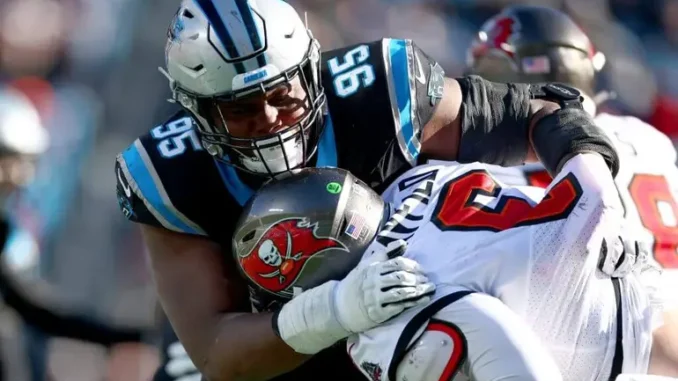
Derrick Brown has quietly been one of the most consistent and disruptive interior linemen in the NFL over the past two seasons. In 2024, Brown logged 63 tackles, 8 tackles for loss, and 4 sacks before a knee injury in Week 14 ended his season prematurely. His absence was immediately felt — Carolina’s run defense cratered, and their pass rush suffered without his push up the middle.
What Happened?
Brown suffered a Grade 2 MCL sprain and a bone bruise — not severe enough for surgery, but enough to shut him down for the rest of the year. Rehab began in January, and he has since been working with the Panthers’ training staff and outside specialists to ensure a full recovery.
Is He Expected Back for Week 1?
Yes. All indications point to Brown being ready for the start of training camp, barring setbacks. The team has been cautious but optimistic. He’s begun light on-field work and strength training as of late April.
Why Is Brown So Important?
Brown’s impact is hard to measure with stats alone. He draws double-teams routinely, collapses pockets, and anchors against the run. His presence frees up edge rushers like Jadeveon Clowney and Yetur Gross-Matos to attack more aggressively. Without him, offenses can stretch the field horizontally with less resistance.
Moreover, Brown’s contract reflects his value: he’s set to count for $18.74 million against the 2025 cap — the third-highest figure on the team.
The Panthers are building their defense around Brown, Jaycee Horn, and Brian Burns (if he returns in free agency), making his health one of the most important storylines this offseason.
3. What’s the Panthers’ Salary Cap Situation?
Entering the 2025 season, Carolina finds itself in a bit of a financial bind — not desperate, but definitely tight.
Current Cap Snapshot
- 2025 NFL Salary Cap: $279.2 million
- Panthers’ Cap Space (as of May): ~$30 million
- Top 7 Contracts Eat Half the Cap:
- Taylor Moton (OT)
- Robert Hunt (OG)
- Derrick Brown (DT)
- Damien Lewis (OG)
- Jadeveon Clowney (EDGE)
- Jaycee Horn (CB)
- Bryce Young (QB)
That’s over $140 million tied up in just seven players — mostly on the trenches and defensive side. While these deals secure foundational players, they leave little room for flexibility unless restructures or cuts occur.
Cap Flexibility: Is There Any Room to Maneuver?
Yes, but with caveats. Carolina has a few options:
- Restructures: Converting base salaries into bonuses could free up $10–15 million. Moton and Hunt are candidates.
- Cuts/Post-June 1 Designations: If performance lags, older veterans (e.g., Shaq Thompson or Hayden Hurst) could become cap casualties.
- Roll-over Cap and 2026 Outlook: The good news? Things get better quickly. The Panthers project to have $150 million in cap space in 2026 and $222 million in 2027.
That’s because many contracts, especially rookie deals and restructured ones, are front-loaded. Combine that with the NFL’s rising cap ceiling, and Carolina could be major players in free agency next year — assuming they don’t burn future space with aggressive restructures now.
4. What Are the Panthers’ Most Pressing Roster Needs?
The Panthers aren’t in full rebuild mode, but they’re definitely in transition. Their most immediate roster concerns heading into the summer include:
- Offensive Line Depth: Injuries hit this group hard in 2024. Adding competition at tackle and center is a must.
- Cornerback Help: Jaycee Horn is elite but injury-prone. Depth behind him is thin.
- Edge Rusher Depth: Clowney is effective but aging. Carolina needs to groom a successor.
- Backup QB: With only Matt Corral and a UDFA behind Bryce Young, an experienced veteran could be added for insurance.
5. Is Bryce Young Ready to Take the Leap in Year 3?
It’s the million-dollar question — literally and figuratively. Young’s 2024 campaign was uneven, though improved from his rookie year. He posted a 62% completion rate with 20 touchdowns to 12 interceptions, but struggled under pressure and often held the ball too long.
The arrival of Canales — known for helping Geno Smith rejuvenate his career in Seattle — is crucial. The offensive staff is installing more quick-read, boot-action concepts designed to simplify Young’s process. Pairing that with the revamped receiving corps should give Young his best shot yet at proving he’s the long-term answer.
If Young breaks out, the Panthers’ rebuild accelerates. If he falters again, Carolina may need to re-enter the QB draft market in 2026 — something no one in Charlotte wants to consider just yet.
Final Word: A Season of Transition and Opportunity
The 2025 season represents a hinge point for the Panthers. The wide receiver room is young and full of promise, Derrick Brown is returning to anchor the defense, and the cap is manageable — for now. But the team’s long-term success depends heavily on how their quarterback, top draft picks, and financial decisions pan out over the next 12 months.
If things break right, Carolina could challenge for a wildcard spot in a winnable NFC South. If not, they’ll at least have laid the groundwork for a more stable 2026