PGMOL Under Pressure as Controversial VAR Decision Sparks Huge Debate After Dramatic Palace Defeat

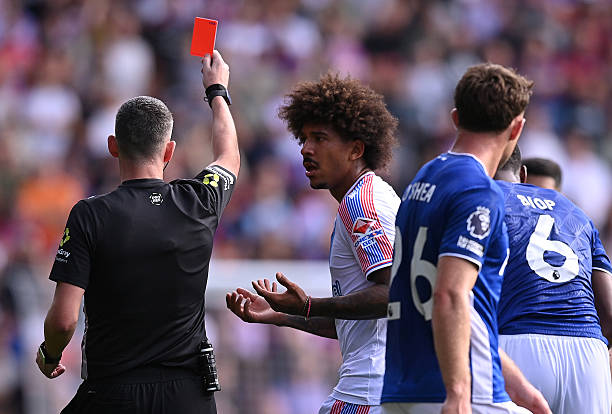
PGMOL Under Pressure as Controversial VAR Decision Sparks Huge Debate After Dramatic Palace Defeat
A dramatic Premier League encounter involving Crystal Palace and Ipswich Town has become the centre of attention after a controversial red-card decision involving Palace defender Axel Disasi sparked widespread debate. The incident, which occurred during a fiercely contested match at Selhurst Park, became one of the biggest talking points of the game and has continued to attract attention because of the involvement of VAR.
The controversy came in the 34th minute, with the score tied at 1-1. Disasi challenged Ipswich Town’s Jack Clarke in a high and forceful tackle that immediately caught the referee’s attention. Initially, the incident became the subject of a VAR review before referee Chris Kavanagh ultimately issued a straight red card to the Crystal Palace defender.
The decision dramatically changed the complexion of the contest. Palace were suddenly forced to continue with 10 men for almost an hour, leaving them with the difficult task of defending while also trying to remain competitive against an Ipswich side looking to take advantage of their numerical superiority.
The red card quickly became a major talking point because of the nature of the challenge. Although the contact itself did not appear to produce a massive impact on the play, the positioning of Disasi’s studs and the timing of the tackle generated significant debate. Some observers questioned whether the punishment was too severe, while others argued that the high studs and force involved justified the referee’s decision.
Former PGMOL chief Keith Hackett also weighed in on the incident, offering a strong defence of the red card. Hackett reportedly argued that the decision was entirely justified, pointing to what he considered excessive force in the challenge. His assessment added another dimension to an already heated debate surrounding the incident.
However, the controversy did not end with the original decision. Attention also turned towards the role played by VAR and the wider officiating process. The incident has subsequently been presented as a major refereeing and VAR talking point, with PGMOL’s position becoming a key part of the discussion.
For Crystal Palace, the sending-off was particularly costly because it forced the team to spend a large portion of the match playing with a numerical disadvantage. Despite that setback, Palace showed considerable character and refused to allow the situation to completely derail their hopes of getting something from the game.
The Eagles fought their way back into the contest and managed to level the score at 2-2 through Jørgen Strand Larsen. The equaliser gave Palace renewed belief and appeared to offer them an opportunity to complete a remarkable comeback despite having been reduced to 10 players.
But the drama continued until the final moments.
Ipswich Town eventually delivered the decisive blow when Zian Flemming scored a 90th-minute winner, condemning Crystal Palace to a dramatic 3-2 defeat at Selhurst Park. After battling back from adversity and twice remaining competitive despite being a man down, Palace ultimately had nothing to show for their efforts.
The result made the red-card decision even more significant in the eyes of supporters and observers. Had Palace been allowed to remain at full strength, questions naturally arise over whether the final outcome might have been different. While nobody can know for certain what would have happened, the sending-off undoubtedly had a major influence on the tactical and competitive dynamics of the match.
The incident has therefore developed into more than simply a disputed refereeing decision. It has become a wider conversation about VAR, consistency in officiating and the threshold for issuing red cards in high-intensity challenges.
For Palace supporters, the frustration will be amplified by the manner of the defeat. After recovering from the setback, scoring twice and fighting until the final whistle, conceding a 90th-minute winner turned what could have been a memorable comeback into a painful defeat.
Meanwhile, the controversy surrounding Disasi’s dismissal is likely to continue generating discussion. With the referee’s decision, the VAR review and subsequent comments from former officiating figures all forming part of the debate, the incident has become one of the defining moments of this Crystal Palace-Ipswich Town encounter.
Ultimately, Palace’s 3-2 defeat will be remembered not only for Flemming’s late winner, but also for the controversial decision that left them playing with 10 men for almost an hour. The debate over whether the red card was correct—and whether VAR handled the situation appropriately—is unlikely to disappear anytime soon.